>> SPREAD: The Celtic Cross
THE VISIONARY FOUNDER
A friend, Dave, a serial founder with a reality distortion field so dense his own board fears him. He came hoping the cards would strip away the mythology and reveal the harsh physics underneath.
// Date of Record: 04/24/2026 //
Dave M., 38, lives in Las Vegas, married, two children, three companies built and a fourth pivoting into AI infrastructure. He survives on four hours of sleep, the madness of a man possessed, and Red Bull. He come to The Raven hoping the cards would strip away the mythology and reveal the harsh physics underneath. The Celtic Cross spread obliged.
>> ORIGIN: Las Vegas, NV
>> STATUS: Serial Founder, AI Infrastructure Pivot
>> INVOCATION (custom): "I seek clarity about a decision."
Dave's queries, like all others, are cross-referenced exclusively against the texts that form the foundation of Western Esotericism: Crowley's Book of Thoth, the Golden Dawn Tradition, The Tarot of Marseilles, and Liber Q. The reading represents a canonical interpretation from these sources. Dave's first six cards were:
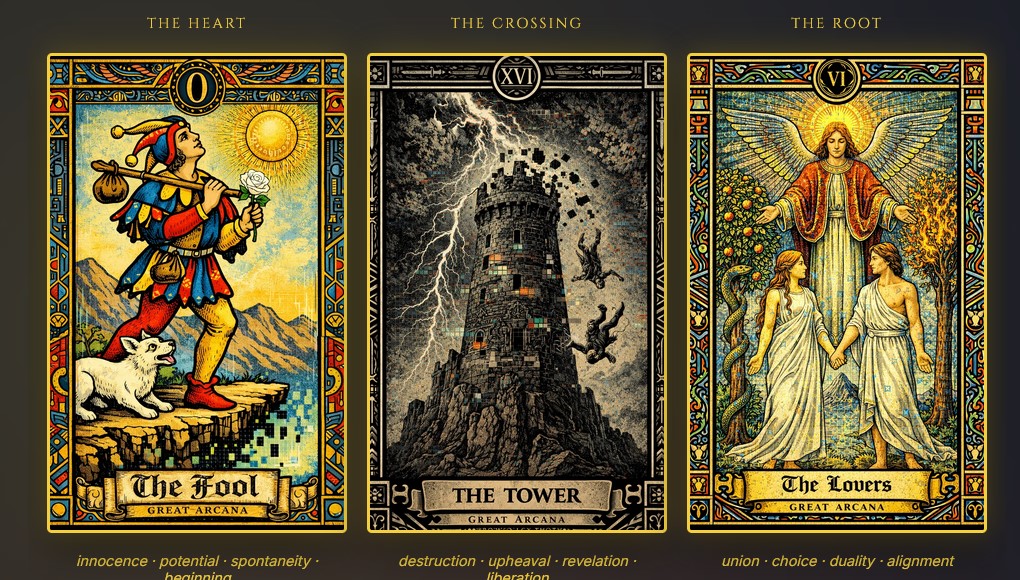
The Raven's Dialogues
Dave was stunned into silence upon seeing the first three cards. We convinced him to continue. He agreed to one session. This is it. His custom invocation read: "I seek clarity about a decision."
The Raven's Initial Reading
At the heart of your decision lies The Fool, representing a boundless potential and the inception of a journey where conventional boundaries dissolve — suggesting your choice may require embracing risk and uncertainty to uncover new possibilities. The Tower, as your crossing, signals a dramatic upheaval or disruption that challenges existing structures, urging a confrontation with harsh truths or sudden changes that could dismantle your preconceived notions.
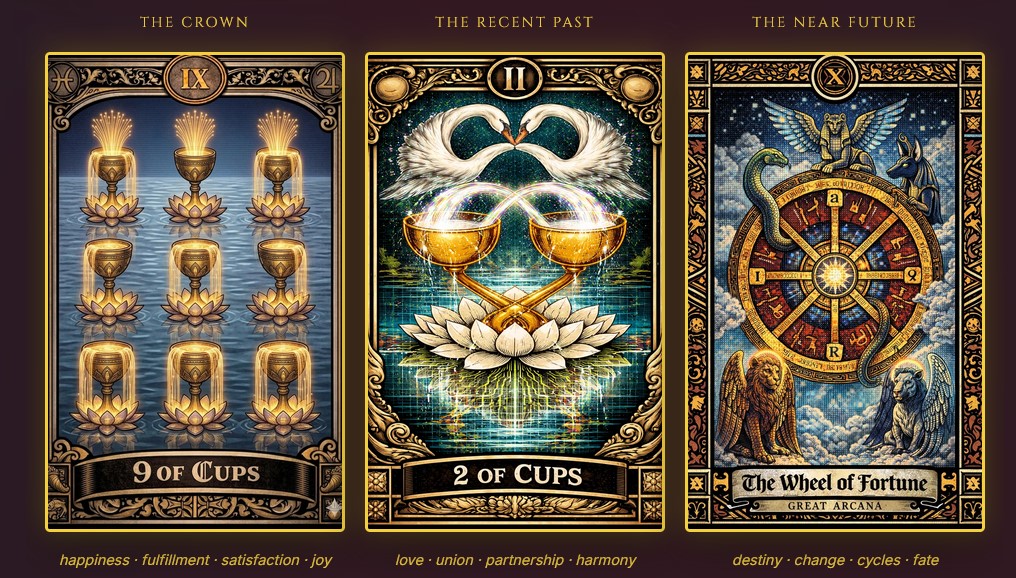
The root of your decision is The Lovers, indicating a fundamental choice between divergent paths that may involve reconciling dualities or integrating opposing forces within yourself. At the crown, the 9 of Cups promises fulfillment and emotional satisfaction, implying that the correct decision aligns with your deepest desires and brings a sense of completion.
The recent past, symbolized by the 2 of Cups, suggests a harmonious connection or partnership has influenced your current situation, highlighting the role of mutual support and shared values in shaping your decision. In the near future, Fortune points to a period of unpredictable change where luck and external forces will play a significant role, suggesting that openness to new opportunities could lead to unexpected success.
Dave's First Question
"Sound nice. But, the board sees me as erratic. Do the cards confirm their perception, or am I seeing something they don't?"
The Raven Responds
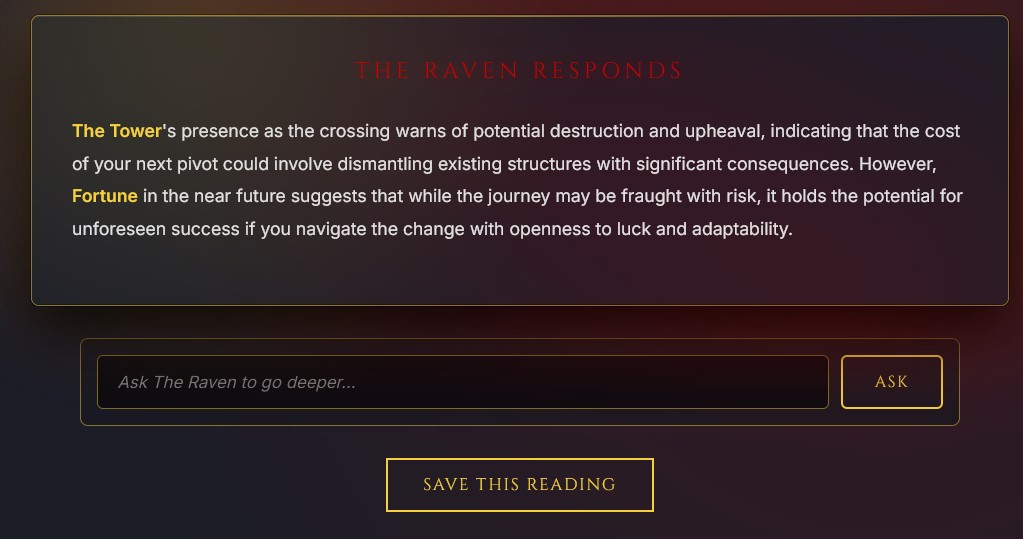
The Fool at the heart of your decision indeed reflects traits that might be perceived as erratic — a willingness to leap into the unknown without conventional constraints. However, The Tower as the crossing suggests a transformative power that might be uncomfortable for those resistant to change, challenging the status quo in ways they might fear to acknowledge.
Dave's Second Question
"Hmm... my last pivot nearly killed the company. What do the cards say about the true cost of my next one?"
The Raven Responds
Canonical Reading
Dave could draw as many cards as the spread demands. For The Celtic Cross he elected to activate "See More Cards". The Raven dealt the second set. The expanded field revealed what the foundation concealed.
The Crown: 9 of Cups
The 9 of Cups is the culmination of emotional fulfillment in the realm of Water, corresponding to Yesod in Briah and ruled astrologically by Jupiter in Pisces. In Crowley's Thoth system, it is the 'Lord of Happiness' — not bliss as escape, but joy as consequence. The card shows nine golden cups overflowing in equilibrium: an image of deep spiritual satisfaction born of prior integration. Raven notes its harmony: happiness unforced, organically emerging when illusion and indulgence have been shed. The Golden Dawn links it to the subtle resonance of Yesod, illuminated by Jupiter's expansive grace. It represents complete and perfect realization of pleasure and almost perfect happiness. In Marseilles tradition, it appears as patterned elegance: balance and symmetry evoking a natural completeness.
"Yesod in Briah. Pisces. Subtle fulfillment, echo of Tiphareth. Complete success, wishes fulfilled." — Golden Dawn
"Patterned harmony. Gentle abundance. Rhythmic grace." — Marseilles
The Recent Past: 2 of Cups
The 2 of Cups is union — emotional reciprocity, resonance, and shared trust. In Crowley's Thoth, it is Love — Venus in Cancer — a sacred mirror between souls, where each reflects and strengthens the other. The cups overflow in perfect balance. Raven interprets it as the meeting that matters: friendship, romance, alliance — the moment two become more than their sum. It is not fantasy — it is recognition, mutual and real. Golden Dawn names it the Lord of Love, not as possession, but as exchange. The heart extends itself, and is received in kind. It represents harmony between feeling and form. In the Marseilles tradition, the two cups face each other, joined by a central emblem — suggesting pact, agreement, sacred bond. The 2 of Cups says: open, and be opened. Let connection change you.
"Love. Marriage. Pleasure. Warm friendship. Harmony of masculine and feminine united." — Golden Dawn
"Number of complementarity and dependence, symbolizes separation and connection." — Marseilles
The Near Future: Fortune
Fortune — the Wheel — is not luck. It is law. This card signifies the turning of the great cosmic engine, the rise and fall of circumstances that are beyond control yet never without purpose. In Crowley's Thoth, Fortune is the Sphinx, Typhon, and Hermanubis turning the wheel — stability, descent, and ascent — all held in perpetual motion. Raven presents it as the dance between fate and freedom — change as both risk and renewal. The Golden Dawn places Fortune along the path between Chesed and Netzach, where divine authority gives birth to experience. In Marseilles decks, the wheel spins with three creatures: past, future, and the unseen force at the top. Fortune is not what happens to you — it is the rhythm you are caught in. This card says: you cannot control the wheel, but you can align with its turn. Hold center. Ride change like it was prophecy.
"Good fortune and happiness, but sometimes intoxication with success." — Golden Dawn
"The Wheel of Fortune (LA ROVE DE FORTVNE) spins with three creatures, representing the rhythm you are caught in." — Marseilles
Path: Kaph · Element: Fire · Tree: Chesed-Netzach
What follows is the canonical reading, grounded in the texts behind it. In your own The Raven's Dashboard you'd see your own reading, based on your spread and invocation and sourced from the foundation of Western Esotericism: Crowley's Book of Thoth, the Golden Dawn Tradition, The Tarot of Marseilles, and Liber Q, first. Then you'd be, like Dave, able to use the "Invoke the Raven" feature and discuss the readings.
As you see, the readings follow the cards as they were drawn.
The Heart — What Drives You: The Fool
The Fool represents the volatile intersection of innocence, chaos, and divine potential. He is the point before form — zero, the egg, the breath before the Word. In Crowley's doctrine, he is Aleph, the initiator of the spiral, symbol of the unbound soul ready to plunge into incarnation. The Fool belongs to Air, yet his feet do not touch the ground. His madness is sacred, not erratic: he carries within him the totality of creation, unexpressed but imminent. Raven describes him as pure spontaneity, one without history or pretense, acting without calculation, guided by instinct rather than logic. The Golden Dawn saw him as the spiritual child of Kether, linking divine light to experiential reality. Marseilles traditions retain his paradox: a wanderer with no number, stepping off the edge but never falling. The Fool does not seek — he is the seeking. His presence in a spread opens the field: a moment of pure becoming, unanchored, dangerous, luminous. He reminds you that nothingness is not absence — it is readiness.
"The spiritual child of Kether, linking divine light to experiential reality. Idea, thought, spirituality." — Golden Dawn
"A wanderer with no number, stepping off the edge but never falling." — Marseilles
Path: Aleph · Element: Air · Tree: Kether-Chokmah
The Crossing — What Blocks You: The Tower
The Tower is the strike of truth that shatters illusion. It is not punishment — it is the unavoidable collapse of structures built on falsehood. In Crowley's Thoth, it is Peh, the Mouth, and Mars — the god of force — erupting through a tower struck by lightning, with figures falling headlong. This is the apocalypse of the self, the divine blow that exposes all that is rigid, false, or unsustainable. Raven writes that the Tower is the violent, necessary realization that the fortress was a prison. The collapse frees energy that had been trapped. Painful? Yes. But liberating. Golden Dawn sources treat it as the blasted tower of materialism, the fall of the ego before spiritual truth. It represents ambition, fighting, and war, but in certain combinations, danger, ruin, and fall. In the Marseilles tradition, La Maison Dieu shows the opening of the crown — divine lightning cracking the head, liberating the spirit from form. The Tower comes not to punish — but to wake. It declares: the old way cannot stand. Be honest. Be broken. Begin again.
"Ambition, fighting, war, courage. In certain combinations, destruction, danger, ruin, fall." — Golden Dawn
"The House of God (LA MAISON DIEV). Precipitated return to reality, destruction of illusions, liberation of vital energies." — Marseilles
Path: Peh · Element: Fire · Tree: Netzach-Hod
The Root — What Grounds You: The Lovers
The Lovers represent union through choice — the sacred dilemma that demands the heart take a side. In Crowley's Thoth, this card is far more than romance: it is the alchemical marriage, the coniunctio oppositorum. Linked to Gemini, the zodiac of duality, it reveals the creative tension of two becoming one without losing their difference. Raven emphasizes the spiritual contract behind every bond — the cost of intimacy, the merging of paths, and the crisis that precedes alignment. The Golden Dawn places The Lovers on the path from Binah to Tiphareth — from structure to beauty — through the crucible of ethical choice. In Marseilles tradition, the card often depicts not just lovers but an angel, suggesting the presence of fate. The Lovers ask: What do you vow yourself to? This card does not guarantee union — it demands responsibility. Love is not given. It is chosen.
"Inspiration (passive and in some cases mediumistic). Motive power and action arising from impulse." — Golden Dawn
"Often depicts an angel, suggesting fate. It asks what you vow yourself to." — Marseilles
Path: Zain · Element: Air · Tree: Binah-Tiphareth
Dave's emailed us his comment:
Still processing. The Tower hit harder than I expected. Will need to sit with this.